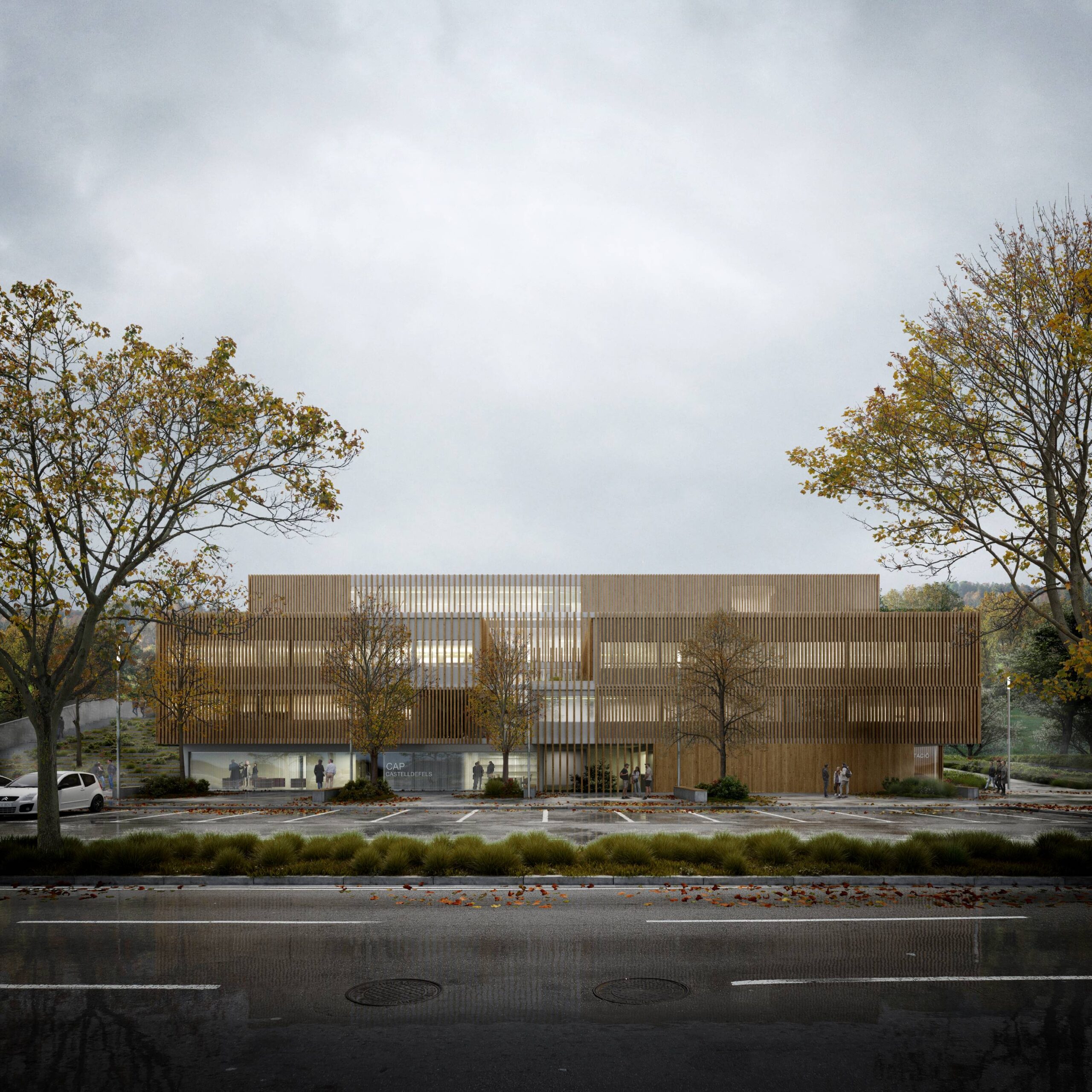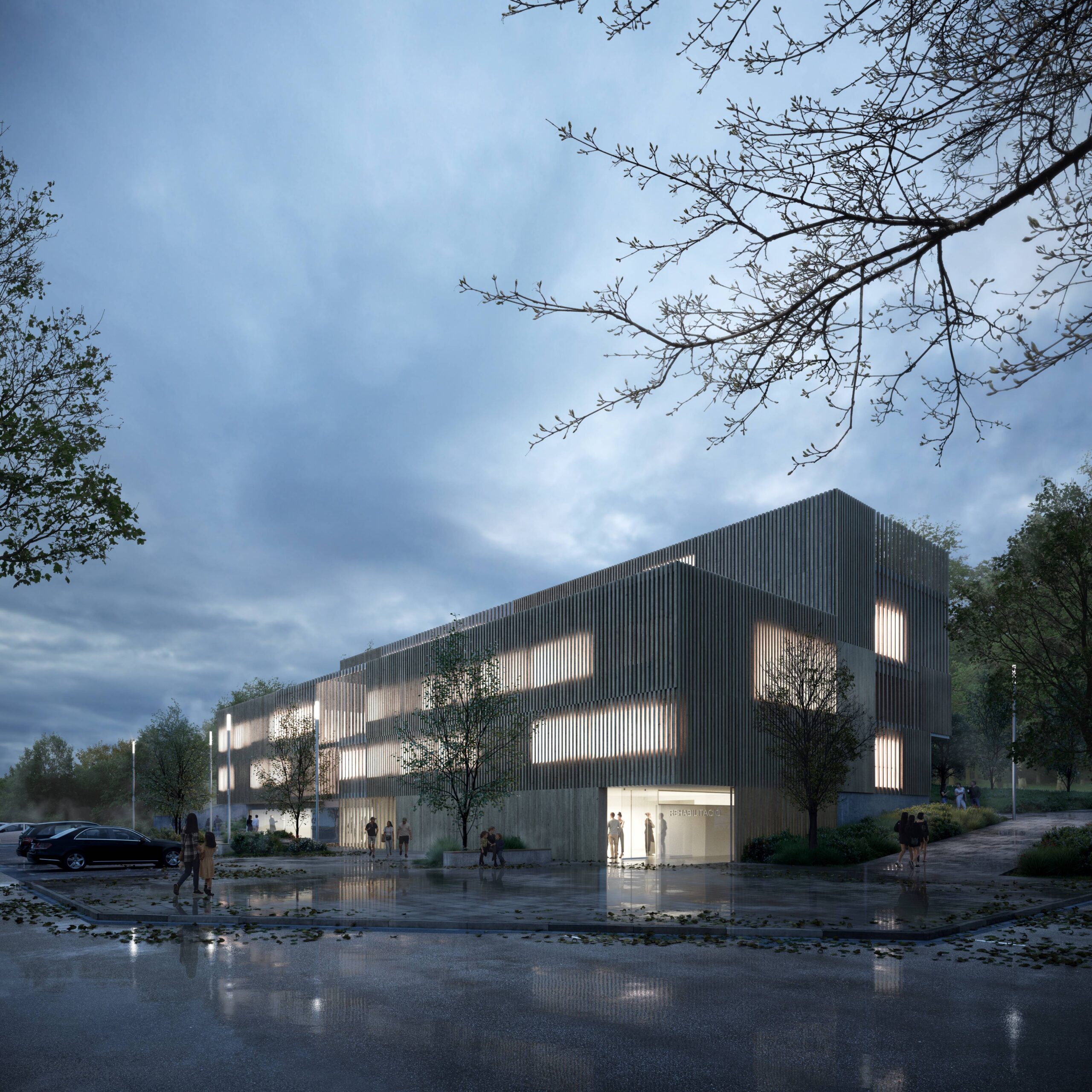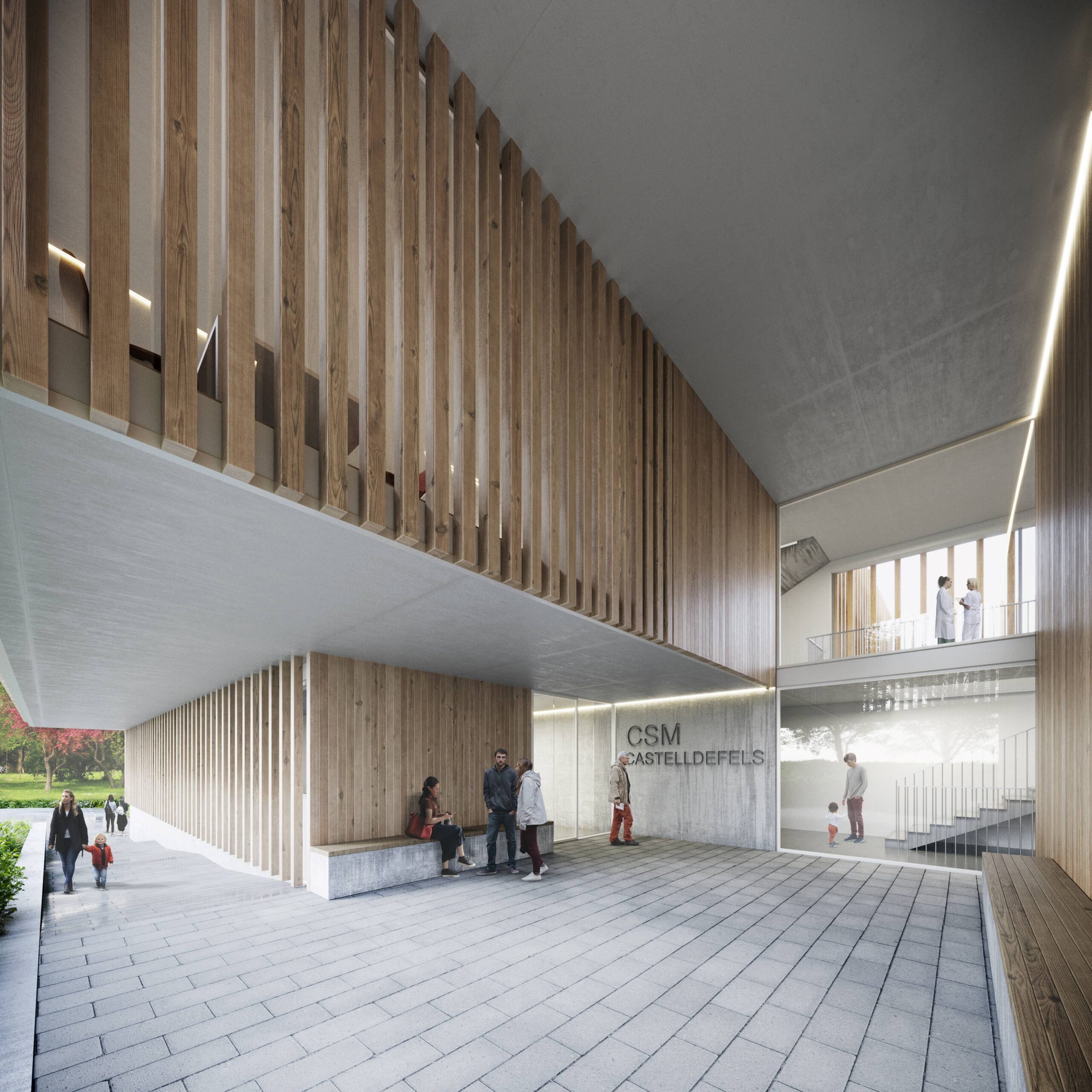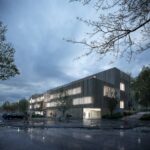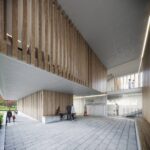
1st Prize: A project defined by high architectural quality, sustainable construction, and a core mission to create spaces where human well-being takes center stage
Context & Integration// The chosen site for the new Castelldefels Primary Care Center (CAP) is located in the northern part of the city, nestled in a privileged setting celebrated for its natural surroundings and excellent views.
Situated at the intersection of Avinguda de Lluís Companys and Carrer del Dr. Trueta, the plot aligns its primary facade with the avenue—the main artery for pedestrian and vehicular traffic. Facing southeast, this avenue offers expansive views of Muntanyeta Park directly opposite. This park, featuring vast stretches of trees and gardens, is a vibrant hub for the Castelldefels community and serves as the natural visual backdrop for the new healthcare center.
Complementing this, the opposite side of the plot borders a quieter area of gardens and sports facilities. These two green zones connect via a passage on the western edge of the site. The plot slopes steeply toward the northwest, a topographical feature that greatly shapes the final architectural response.
Architectural Proposal // The architectural proposal is built upon three fundamental principles:
-
Adapting the building gracefully to the plot’s steep topography.
-
Integrating three distinct healthcare services into a single facility, ensuring they function independently while remaining seamlessly interconnected.
-
Maximizing the dual orientation and views toward both the park and the rear gardens/sports area.
To achieve this, the new CAP is structured around a central spine (or “motherboard”) that runs longitudinally across the plot from end to end. This central core houses all the building’s service elements: vertical circulation (stairs and elevators), lobbies, restrooms, and utility shafts. It serves as the main connector through which the different healthcare departments (Primary Care, Mental Health, and Rehabilitation) communicate, eliminating the need for transit through interior clinical or treatment spaces.
This element functions as a motherboard featuring multiple “slots” where the various clinical areas (or “components”) connect. While these components are configured differently according to their functional program, they all share the same layout: a flexible threshold space (waiting room, reception, or open-use area) connects them to the central service spine. This layout places the primary functional spaces along the exterior facade, ensuring they always benefit from natural light, cross-ventilation, and open views.
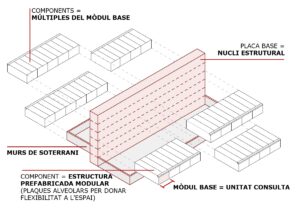
Building configuration diagram.
Working with these equivalent modular components streamlines adaptation to varying zoning height regulations. It also allows certain “slots” or connection points to remain open. As a result, despite the building’s compact footprint, natural light, ventilation, and views penetrate deep into the innermost spaces. Furthermore, this design allows the southeastern half to feature a lower profile that respects the scale of the park across the avenue, while positioning the tallest volume on the opposite side.
Circulations// Centering all services and circulation within a single spine establishes a consistent organizational layout across all floors. This provides intuitive navigation for both patients and healthcare professionals. It allows the three main departments—Primary Care, Rehabilitation, and Mental Health—to operate as fully independent services while maintaining internal connectivity through the central core.
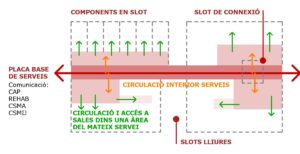
Diagram of the internal circulation levels.
Materiality and Enviroment// The choice of timber as the primary material for both the structure and the building envelope seamlessly integrates the facility into the green corridor formed by Muntanyeta Park and the CEM Can Roca Sports Area. Additionally, designing all rooftops as green roofs ensures that despite the new construction, the project preserves a “green footprint”, aligning with the Town Council’s Special Plan to expand the city’s green infrastructure.
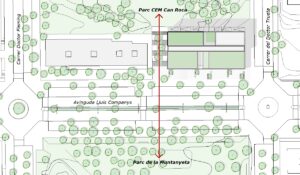
Site plan: The new CAP as a green extension of Muntanyeta Park towards Can Roc
Sustainability criteria// The project leverages the site’s natural environmental conditions—orientation, views, and vegetation—making sustainability the core driver of the design. The strategy focuses on three pillars: environmental control through the building envelope, reduction of energy demand, and maximizing natural light and cross-ventilation. These principles were integrated from the earliest design phases to achieve a building with minimal life-cycle environmental impact.
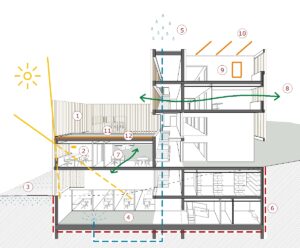
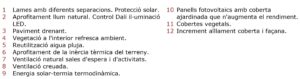
Diagram of the sustainability of the proposal
The structural system features a timber frame rigidified by the central service spine. Each functional department is housed within a timber module composed of beams spanning from the central core to a perimeter of timber columns. bThe floor slabs are also designed using a timber framework with rock wool insulation sandwiched between panels, providing excellent thermal and acoustic performance. This creates flexible, column-free interior spaces that can easily adapt to future layout changes.
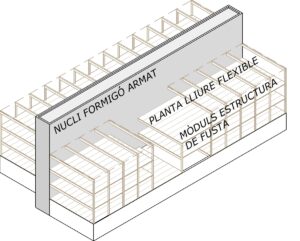
Diagram of the estructures proposal