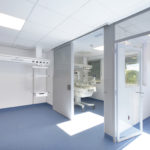
The project encompasses the comprehensive renovation of the Emergency area and the Neonatal (NICU) and Pediatric Intensive Care Units (PICU) on the third floor of the Dr. Josep Trueta University Hospital in Girona. The intervention reconfigures the space to align with contemporary healthcare standards, promoting continuous family presence and placing developmental care for newborns at the core of the design.
Layout & Organization// To maximize usable floor area and streamline clinical workflows, the existing perimeter visitor corridor was eliminated. This key move allowed for the expansion of the clinical area and a complete spatial reorganization:
-
Expansion of PICU and NICU: Addition of three new bays for the PICU, alongside bays A and B dedicated to the NICU.
-
Specialized Isolation Suite: Integration of an isolation bay within the PICU, as well as two independent isolation rooms: a larger room designed for infectious disease isolation, and a dedicated compassionate care isolation bay, engineered to offer a serene, private environment for family accompaniment during critical moments.
Uniqueness & Character// The architectural proposal emphasizes environmental quality to enhance the well-being of young patients, visiting families, and healthcare staff. By utilizing interior transparencies, glass partitions, and a strategic color palette across wall surfaces, the intervention creates a reassuring, demedicalized atmosphere. A hallmark feature of the project is the control of natural and artificial lighting, designed to preserve circadian rhythms—a vital factor for infant neurodevelopment as well as staff alertness during demanding shifts.
Sustainability Criteria// The project was executed following strict criteria for energy efficiency and environmental responsibility:
-
Waste Minimization: Demolition was kept to a minimum by retaining selected existing partition walls, drastically reducing construction waste.
-
Dry Construction & Industrialization: Specification of lightweight, pre-engineered, and prefabricated dry construction systems that lower embodied energy and streamline installation within an active hospital environment.
-
Envelope Performance: Replacement of exterior window joinery to enhance overall thermal and acoustic insulation.
-
Daylight Penetration: Extensive use of interior glass partitions to allow natural daylight to reach deep into the central areas of the unit.